Blogging again.
June 26, 2019.
After a lovely, easy, three-year ride on a two-drug myeloma
regimen, my right shoulder was hurting and a PET scan showed a lesion (a
collection of myeloma cells showing bright red) in my right scapula.
M-spike and IgG hadn't changed, but Lambda Light Chains had more than doubled.
The myeloma was back. It never gives up.
My Mayo doctor ordered radiation treatment of that lesion, and added
dexamethasone to the two-drug therapy. Now, a month later, the ten
radiation treatments are complete and I'm taking the dex. Last week's
blood test showed Lambda light chains back down to normal again, a very
good sign.
Another PET scan and doctor's appointment in a couple of months will tell us whether that scapula
really is better. I think it is, because my shoulder doesn't hurt any more. It itches a little, because the radiation lightly toasted the skin over the scapula, but I don't mind and it will heal.
A lesson learned: A lesion formed but neither M-Spike nor IgG went up, which means that at least some of my myeloma is "nonsecretory" (doesn't secrete monoclonal proteins). Therefore we'll have to pay more attention to Lambda Light Chains. Maybe I'll need more PET scans too? I wonder if there's a limit on those these days. Checking Lambda Light Chains is just a simple blood draw for a lab test, though it's nowhere near as comprehensive as a PET.
Showing posts with label myeloma. Show all posts
Showing posts with label myeloma. Show all posts
Wednesday, July 31, 2019


Friday, August 19, 2016
All Good News
Friday, August 19, 2016:
Wednesday I brought a Mayo Clinic blood draw "kit" to the local clinic, where they drew the blood and shipped it overnight back to Mayo. Last evening the results showed up on Mayo's patient portal, and I'm happy!
Since early April my treatment regimen has been 2 mg of Pomalyst every day, with infusions of Darzalex every week and then every other week, currently with 12 mg of dexamethasone (DEX) on the weeks between Darzalex infusions. During that time my IgG and M-Spike dropped about 20% per month until a month ago, then leveled off.
 Wednesday's results confirmed that IgG and M-Spike are stable, at least for now. IgG was 515 mg/dL two months ago, 544 last month, and 506 on Wednesday. M-Spike followed a similar pattern and was 0.5 g/dL on wednesday. These numbers are as low as they have ever been since my diagnosis 13 years ago, and just a third of their values of last April. The chemo regimen is doing a great job for me.
Where to from here? Could we cut the Pomalyst or the DEX? It's nice to think about, but mostly I'm just happy to be stable for now and content to wait another month. I suppose another PET scan is indicated, to be sure that the lesions in my vertebrae have faded back (as I think they have), but I can wait for that too. I haven't heard from Dr WG at Mayo yet - perhaps he will have a different idea.
I also had a heart disease scare in the last marathon, but a recent stress test was normal, actually better than normal, so I think the angina-like symptoms were caused by acid reflux. Also, because my most recent colonoscopy was ten years in the past, the doc ordered one of those and that too was negative. I feel thoroughly checked out and ready to run a few more marathons!
Wednesday I brought a Mayo Clinic blood draw "kit" to the local clinic, where they drew the blood and shipped it overnight back to Mayo. Last evening the results showed up on Mayo's patient portal, and I'm happy!
Since early April my treatment regimen has been 2 mg of Pomalyst every day, with infusions of Darzalex every week and then every other week, currently with 12 mg of dexamethasone (DEX) on the weeks between Darzalex infusions. During that time my IgG and M-Spike dropped about 20% per month until a month ago, then leveled off.

Where to from here? Could we cut the Pomalyst or the DEX? It's nice to think about, but mostly I'm just happy to be stable for now and content to wait another month. I suppose another PET scan is indicated, to be sure that the lesions in my vertebrae have faded back (as I think they have), but I can wait for that too. I haven't heard from Dr WG at Mayo yet - perhaps he will have a different idea.
I also had a heart disease scare in the last marathon, but a recent stress test was normal, actually better than normal, so I think the angina-like symptoms were caused by acid reflux. Also, because my most recent colonoscopy was ten years in the past, the doc ordered one of those and that too was negative. I feel thoroughly checked out and ready to run a few more marathons!
Sunday, June 12, 2016
Review of ICER Report on Treatment Options for Multiple Myeloma
Who is ICER?
ICER is the Institute for Clinical and Economic Review. As far as I can tell, it is funded primarily by insurance companies and by nonprofit organizations who, in turn, are funded by insurance companies. They claim some funding by the federal government as well. Other members include pharmaceutical companies who apparently participate in order to have some voice in ICER's proceedings. A quick Google search shows that the title of many of ICER's documents is "Building Trust through Rationing," which I believe is their mantra and suggests that rationing health care is their real purpose.
ICER deals in statistics, not medicine, and a primary goal is to control costs. I assume that this is why they don't want participation by patients. They have been working on a report for multiple myeloma, and we myelomiacs have been concerned that they would produce a one-size-fits-all treatment algorithm that doctors might be expected to follow and insurers might try to enforce.
Garbage In, Garbage Out
ICER issued their final report on Myeloma on June 9, 2016, attempting to grade different myeloma treatments to provide comparative medical and cost values. In my opinion this report is ridiculous on its face, saved only by one of its final recommendations. ICER claims to have found over a thousand potentially relevant literature references to myeloma treatment, considered 38 worth reading, and exactly six Phase III studies worth analyzing to form their conclusions.
Thus they chose to ignore all Phase I and Phase II studies, which provide by far the largest part (I'd guess 90%?) of the current, up-to-date information that the FDA uses for myeloma drug approval and that doctors actually use in their day-to-day care of myeloma patients. For this reason, ICER's entire analysis is fatally flawed. As we say in the computer industry: "Garbage in, garbage out."
Blinders
As just one example of this blinders approach, the report ignores an old but widely-used myeloma treatment called cyclophosphamide (Cytoxan), which is frequently combined with dexamethasone (DEX) and either bortezomib (Velcade) or lenalidomide (Revlimid). Indeed, many patients will recognize cyclophosphamide with bortezomib and DEX as the CyBorD regimen. Because cyclophosphamide is relatively low in cost, it certainly should have been included in any economic analysis, but it appears nowhere except peripherally in the addenda.
ICER's peculiarly superficial analysis also minimizes or omits many other commonly-used and highly-effective regimens. Worst of all, it gives especially poor grades to the treatments that are newest and possibly the most effective, such as pomalidomide (Pomalyst) and daratumumab (Darzalex).
Saved by the disclaimer:
One recommendation near the bottom of the final report and in the shorter Report-at-a-Glance, saves the report from total disrepute. This appears under the heading "Insurers:"
My bottom line opinions:
Whether you agree or disagree, or have a factual correction, you are invited to comment. - Don
ICER is the Institute for Clinical and Economic Review. As far as I can tell, it is funded primarily by insurance companies and by nonprofit organizations who, in turn, are funded by insurance companies. They claim some funding by the federal government as well. Other members include pharmaceutical companies who apparently participate in order to have some voice in ICER's proceedings. A quick Google search shows that the title of many of ICER's documents is "Building Trust through Rationing," which I believe is their mantra and suggests that rationing health care is their real purpose.
ICER deals in statistics, not medicine, and a primary goal is to control costs. I assume that this is why they don't want participation by patients. They have been working on a report for multiple myeloma, and we myelomiacs have been concerned that they would produce a one-size-fits-all treatment algorithm that doctors might be expected to follow and insurers might try to enforce.
Garbage In, Garbage Out
ICER issued their final report on Myeloma on June 9, 2016, attempting to grade different myeloma treatments to provide comparative medical and cost values. In my opinion this report is ridiculous on its face, saved only by one of its final recommendations. ICER claims to have found over a thousand potentially relevant literature references to myeloma treatment, considered 38 worth reading, and exactly six Phase III studies worth analyzing to form their conclusions.
Thus they chose to ignore all Phase I and Phase II studies, which provide by far the largest part (I'd guess 90%?) of the current, up-to-date information that the FDA uses for myeloma drug approval and that doctors actually use in their day-to-day care of myeloma patients. For this reason, ICER's entire analysis is fatally flawed. As we say in the computer industry: "Garbage in, garbage out."
Blinders
As just one example of this blinders approach, the report ignores an old but widely-used myeloma treatment called cyclophosphamide (Cytoxan), which is frequently combined with dexamethasone (DEX) and either bortezomib (Velcade) or lenalidomide (Revlimid). Indeed, many patients will recognize cyclophosphamide with bortezomib and DEX as the CyBorD regimen. Because cyclophosphamide is relatively low in cost, it certainly should have been included in any economic analysis, but it appears nowhere except peripherally in the addenda.
ICER's peculiarly superficial analysis also minimizes or omits many other commonly-used and highly-effective regimens. Worst of all, it gives especially poor grades to the treatments that are newest and possibly the most effective, such as pomalidomide (Pomalyst) and daratumumab (Darzalex).
Saved by the disclaimer:
One recommendation near the bottom of the final report and in the shorter Report-at-a-Glance, saves the report from total disrepute. This appears under the heading "Insurers:"
Multiple myeloma is a condition in which many patients will cycle through most or all available treatments, and there is substantial variation in drug mechanisms of action and in the personal patient values that guide consideration of the trade-offs between extended survival and different side effect profiles. Given this background, and in the absence of better evidence, payers should not consider step therapy or “fail first” coverage policies for myeloma treatments.Amen. This statement seems to have two important implications:
- ICER recognizes that their report has no value in guiding treatment for any particular patient (i.e. it turns out that we wasted our time producing this report); and
- The PATIENT (the payer) is responsible for choosing an insurer or a plan which does not demand step therapy or "fail-first."
My bottom line opinions:
- A doctor attempting to use the results of this ICER report as the primary guide for treating a patient would be committing medical malpractice, and if so
- It follows that an insurance company or plan that denied coverage based upon this report would be demonstrating a singular contempt for their own client, the policyholder.
Whether you agree or disagree, or have a factual correction, you are invited to comment. - Don
Saturday, March 6, 2010
March 4, 2010, end of Cycle 26:
Two years ago this week, I started on a trial of the new drug pomalidomide (then called CC-4047) with dexamethasone (DEX). Within a few months my M-spike was down from 2.7 to 1.0 g/dL, where it has remained since, going as low as 0.8 and as high as 1.1. Pomalidomide is good stuff. It seems to produce a response in most myelomiacs, including many for whom other treatments have failed to work. I do hope that Celgene and the FDA can get together quickly and get it approved.
I am currently taking only two prescribed drugs: (1) Pomalidomide, 2 mg per day; and (2) Aspirin, 325 mg per day. I would also take acyclovir to ward off shingles, but acyclovir is hard to get right now.
M-spike was unchanged at 1.0 g/dL at the end of this 28-day cycle. IgG was down 4% at 1130 mg/dL, which is probably good - IgI varies. Lambda free light chains (FLCs) are down a surprising 24%, yet Kappa FLCs are up, suggesting that the Lambda decrease is genuine. I'm not sure what the decrease in Lambda means, but it can't be bad. Total white cell count was 3.4 K/uL, down slightly to the lowest value I've ever had, just below the bottom of the reference range. But the white count bounces around, and neutrophils even went up a little, so we'll just watch it.
At worst, the tumor burden appears stable, despite discontinuing DEX three cycles ago, and at best it may have decreased just a little. Furthermore, neutrophils have stopped their downward slide. I'm a happy camper.
Dr L also ordered a bone-density (DEXA) scan this time. The result for the lumbar spine, vertabrae L1-L4, is a decrease in absolute density of 2% compared with another scan 2 1/2 years ago at a different facility. I'd rather it was an increase, but there could be that much variation between machines, and I'll take it. Results for the femur are less clear to me, because the previous facility reported only one value for femur, and Mayo reported two, called "femur neck" and "total hip." If the "femur neck" value is comparable to the femur value from the previous report, then density actually went up by about 5%. This is possible, because Vitamins D3 and K2 are known to strengthen bones, and I take them very regularly. In any case I still have osteopenia, but not osteoporosis, and I hope to discuss this more with Dr L.
Differences this cycle:
I've been taking curcumin 8 g/day, sixteen capsules, and I'm tired of doing that. I might even say I hate it. Curcumin could be helping, but I have little evidence, so I'll stop it and see what happens. Quercetin too. I'll go back to one 500 mg capsule of curcumin per day, and no quercetin, reducing my daily consumption by 23 capsules. Yay!
The chlorophyllin supplement is new, and I will continue that, to support the neutrophils and because it is a good anti-mutagenic agent. I will also take one naproxen capsule per day. I use the liquid type, in the hope that it will be less likely to burn a hole in my innards as some NSAIDs can do.
Some current test results:
Related links:
Leftover organic chicken or turkey, baked organic sweet potato slices, organic broccoli, jalapena tomato sauce.

I am currently taking only two prescribed drugs: (1) Pomalidomide, 2 mg per day; and (2) Aspirin, 325 mg per day. I would also take acyclovir to ward off shingles, but acyclovir is hard to get right now.
M-spike was unchanged at 1.0 g/dL at the end of this 28-day cycle. IgG was down 4% at 1130 mg/dL, which is probably good - IgI varies. Lambda free light chains (FLCs) are down a surprising 24%, yet Kappa FLCs are up, suggesting that the Lambda decrease is genuine. I'm not sure what the decrease in Lambda means, but it can't be bad. Total white cell count was 3.4 K/uL, down slightly to the lowest value I've ever had, just below the bottom of the reference range. But the white count bounces around, and neutrophils even went up a little, so we'll just watch it.
At worst, the tumor burden appears stable, despite discontinuing DEX three cycles ago, and at best it may have decreased just a little. Furthermore, neutrophils have stopped their downward slide. I'm a happy camper.
Dr L also ordered a bone-density (DEXA) scan this time. The result for the lumbar spine, vertabrae L1-L4, is a decrease in absolute density of 2% compared with another scan 2 1/2 years ago at a different facility. I'd rather it was an increase, but there could be that much variation between machines, and I'll take it. Results for the femur are less clear to me, because the previous facility reported only one value for femur, and Mayo reported two, called "femur neck" and "total hip." If the "femur neck" value is comparable to the femur value from the previous report, then density actually went up by about 5%. This is possible, because Vitamins D3 and K2 are known to strengthen bones, and I take them very regularly. In any case I still have osteopenia, but not osteoporosis, and I hope to discuss this more with Dr L.
Differences this cycle:
- Dr L ordered 3 days of Biaxin at the beginning of the cycle. More about that below.
- My 30-year chronic headache has started to return, now that I'm off DEX, and I took a capsule of naproxen sodium whenever the headache reminded me, once every day or two. Two years ago, not long after the trial started, the decline in M-spike gradually leveled off in the same months that I gradually stopped using naproxen. Was there a cause and effect? Since Celebrex (celecoxib), a similar NSAID, is thought to have a modest anti-myeloma benefit, it is possible that naproxen might also. In my amateurish and hopeful opinion, it is even possible that pomalidomide and naproxen might be synergistic. If so, we'll take advantage of it.
- I started taking a new supplement, sodium copper chlorophyllin, one week before the blood draw. A recent article in Life Extension Magazine suggests that chlorophyllin may support neutrophil counts during chemotherapy. My neutrophil count did stop falling this time, actually going up slightly from 1.22 to 1.29 K/uL. Neutrophils bounce around a lot however, in response to bacterial threats in the body, so this is not very significant.
- We ran another marathon eleven days ago. I've never noticed that a marathon affects the myeloma results, though.
- Biaxin (clarithromycin) is known to potentiate the combination of DEX and an IMID drug, such as Revlimid or thalidomide, and probably pomalidomide. Biaxin is no help by itself, and no one knows whether it would work with ONLY the IMID drug, without the DEX. Dr L prescribed a three-day course of Biaxin a month ago, to prevent a minor skin injury from becoming a major infection. Could those three days of Biaxin have helped the pomalidomide work on my tumor burden, even though I'm not taking DEX, and even though only three days?
- She looked at the skin injury, now just a red spot, and thought it was healing rather slowly. In contrast, I thought it was healing fairly quickly compared with similar, prior experiences on DEX.
- I asked if neutrophils are important to warding off shingles, since my neutrophils are slightly below the bottom of the reference range. She said no, that neutrophils attack bacterial infections, and lymphocytes are more important for shingles and other viruses. Happily, my lymphocytes are smack in the middle of the reference range.
- Somehow the subject of Velcade came up, and she expressed the opinion that Velcade might not be in my short-term future, even if pomalidomide begins to fail, because the twice-weekly infusions and the attendant neuropathy would mess up my very-active lifestyle. I didn't mention that I would prefer once-weekly infusions, and by the way whose lifestyle is NOT messed up by Velcade infusions? I was happy with her patient-centered concern though. Anyway the discussion of the NEXT treatment after pomalidomide seems farther off now that it did a cycle ago.
- I don't recall how this came up, but at one point Dr L said that in a given instance there may be a choice between any of several treatments, all of them good, none of them wrong. Anyway that's what I thought I heard - there may not be a BEST choice.
- I had a bone-density (DEXA) scan this time. When the results of the scan were unknown, I mentioned to Dr L that if a bisphosphonate is indicated, I have a very strong preference for oral rather than IV. To my surprise she agreed wholeheartedly, saying that new information is coming out indicating that myeloma doctors may be over-treating with the IV meds (Aredia and Zometa). The half-life of those bisphosphonates in the bones is 10 years (or did she say 20 years). Too much bisphosphonate may stop the bones from losing density, but the bones may not regenerate themselves. Instead they become brittle and subject to fracture, especially the femur near the hip. Mayo will be coming out with a modification of their mSMART protocols, which may include oral bisphosphonates. At least three different oral bisphosphonates are available, and she wasn't yet sure which she might prefer for me. I think I'd also consult with my primary care physician, my other Dr L, who has a lot of experience with oral bisphosphonates.
I've been taking curcumin 8 g/day, sixteen capsules, and I'm tired of doing that. I might even say I hate it. Curcumin could be helping, but I have little evidence, so I'll stop it and see what happens. Quercetin too. I'll go back to one 500 mg capsule of curcumin per day, and no quercetin, reducing my daily consumption by 23 capsules. Yay!
The chlorophyllin supplement is new, and I will continue that, to support the neutrophils and because it is a good anti-mutagenic agent. I will also take one naproxen capsule per day. I use the liquid type, in the hope that it will be less likely to burn a hole in my innards as some NSAIDs can do.
Some current test results:
| Test | Dec 10 | Jan 07 | Feb 04 | Mar 04 | Remarks | |||||
| M-spike g/dL | 0.9 | 1.0 | 1.0 | 1.0 | Best tumor measure | |||||
| IgG mg/dL | 1090 | 1110 | 1180 | 1130 | Variation is normal | |||||
| L FLC mg/dL | 2.36 | 2.18 | 2.78 | 2.10 | L Free light chains | |||||
| Calcium mg/dL | 10.0 | 9.6 | 9.8 | 10.1 | Below 10.2 is best | |||||
| Creat mg/dL | 1.1 | 1.1 | 1.1 | 1.0 | Kidney, normal | |||||
| HGB g/dL | 14.3 | 14.4 | 14.2 | 14.7 | Hemoglobin, normal | |||||
| RBC M/uL | 4.00 | 4.05 | 4.00 | 4.17 | Red cell count, low | |||||
| WBC K/uL | 3.7 | 3.5 | 3.8 | 3.4 | White cells, low | |||||
| ANC K/uL | 1.55 | 1.38 | 1.22 | 1.29 | Neutrophils, low |
Related links:
| My Myeloma | A discussion of my myeloma, not very technical. | |
| My Treatment History | Not technical. | |
| My Test Charts | Graphic displays of several key test results over time. | |
| My Test Result Table | Best with a wide browser window. Somewhat technical. | |
| My Supplements | With links to where I buy them. |
Leftover organic chicken or turkey, baked organic sweet potato slices, organic broccoli, jalapena tomato sauce.

Saturday, January 9, 2010
When The Receptionist Knows Your Name
January 7, 2010, end of Cycle 24:
You know you're battling cancer when the receptionist at the Mayo Clinic Hematology desk knows your name as you walk in. Happened Thursday.
24 cycles of the pomalidomide (CC-4047, Actimid) study are complete, and it's been a great ride. Not over yet, but Thursday was a hint that it might be over before long. Or was it a hint? The worst news, really, was that M-spike went from 0.9 to 1.0 g/dL. I stopped dexamethasone (DEX) completely for this cycle, the first cycle without it, and M-spike inched up. Maybe. Although M-spike tracks the tumor burden most closely, it is not especially accurate, and IgG only went up a little, from 1090 to 1100 mg/dL, so maybe it didn't really change. IgG is a measure of ALL immunoglobulins, including the monoclonal ones that make up M-spike, so if M-spike goes up by 0.1 g/dL, then IgG has to go up by 100 mg/dL, all else being equal. So I don't know whether to cry in my beer or not. I guess I'll just drink it.
I did try to stave off an increase, with curcumin 8 grams per day and quercetin 4 grams per day during this cycle. Did they help? No way to know, but if they did, they didn't help enough to send M-spike southward. I've also taken ashwagandha for three cycles now, one capsule per day, and I think I'll probably stop that because it made no noticeable improvement for any of the three cycles. I'll keep taking the curcumin and quercetin for another cycle, on the theory that M-spike might have been worse without them.
The other bad news is that my neutrophil count has dropped to 1.38 K/uL, its lowest level ever and well below the bottom of the reference range, which is 1.70 K/uL. Further, my white cell count (which includes neutrophils) confirms this, dropping by just about the same amount. This is one of several possible pomalidomide side effects. I had thought I was immune to this problem, but now that I look closely, both of these numbers have edged downward during the 24 cycles. They bounce around a lot, because neutrophils and other white cells respond to microbial threats in the body, but the trend line tilts slightly downward, as indicated by the blue dots in this chart.
It's possible that those white counts are down partly because my body just hasn't encountered any threats lately. Somehow, I successfully navigated all of the Christmas and New Year's parties, plus a grandson visit, without catching anything. Whatever the reason, however, without sufficient neutrophils a person could develop a life-threatening neutropenic fever, so the pomalidomide study requires a neutrophil count of at least 1.00 K/uL. To keep the count high enough the regimen can be changed, from pomalidomide every day to three weeks on and one week off. If that isn't enough, there may be another way to reduce the dosage, perhaps taking the 2-mg capsules every other day, though we didn't discuss that. Getting ahead of myself here.
Running seems to be going a bit better without the DEX. Dr KDS says that it may take a couple of months for the DEX effects to wear off entirely. I do notice that a small open skin scrape on one ankle has healed over since stopping the DEX, and other little skin injuries heal faster too. I imagine that the microscopic muscle, tendon, and bone injuries that a runner gets all of the time will also heal more quickly. If so, they won't develop into painful injuries that would require me to stop or slow the training. We'll see. Several more marathons ahead this year, if all goes well.
Some current test results:
Related links:
Sunshine made this. I ate it for dinner. Yum.

You know you're battling cancer when the receptionist at the Mayo Clinic Hematology desk knows your name as you walk in. Happened Thursday.
24 cycles of the pomalidomide (CC-4047, Actimid) study are complete, and it's been a great ride. Not over yet, but Thursday was a hint that it might be over before long. Or was it a hint? The worst news, really, was that M-spike went from 0.9 to 1.0 g/dL. I stopped dexamethasone (DEX) completely for this cycle, the first cycle without it, and M-spike inched up. Maybe. Although M-spike tracks the tumor burden most closely, it is not especially accurate, and IgG only went up a little, from 1090 to 1100 mg/dL, so maybe it didn't really change. IgG is a measure of ALL immunoglobulins, including the monoclonal ones that make up M-spike, so if M-spike goes up by 0.1 g/dL, then IgG has to go up by 100 mg/dL, all else being equal. So I don't know whether to cry in my beer or not. I guess I'll just drink it.
I did try to stave off an increase, with curcumin 8 grams per day and quercetin 4 grams per day during this cycle. Did they help? No way to know, but if they did, they didn't help enough to send M-spike southward. I've also taken ashwagandha for three cycles now, one capsule per day, and I think I'll probably stop that because it made no noticeable improvement for any of the three cycles. I'll keep taking the curcumin and quercetin for another cycle, on the theory that M-spike might have been worse without them.
The other bad news is that my neutrophil count has dropped to 1.38 K/uL, its lowest level ever and well below the bottom of the reference range, which is 1.70 K/uL. Further, my white cell count (which includes neutrophils) confirms this, dropping by just about the same amount. This is one of several possible pomalidomide side effects. I had thought I was immune to this problem, but now that I look closely, both of these numbers have edged downward during the 24 cycles. They bounce around a lot, because neutrophils and other white cells respond to microbial threats in the body, but the trend line tilts slightly downward, as indicated by the blue dots in this chart.
It's possible that those white counts are down partly because my body just hasn't encountered any threats lately. Somehow, I successfully navigated all of the Christmas and New Year's parties, plus a grandson visit, without catching anything. Whatever the reason, however, without sufficient neutrophils a person could develop a life-threatening neutropenic fever, so the pomalidomide study requires a neutrophil count of at least 1.00 K/uL. To keep the count high enough the regimen can be changed, from pomalidomide every day to three weeks on and one week off. If that isn't enough, there may be another way to reduce the dosage, perhaps taking the 2-mg capsules every other day, though we didn't discuss that. Getting ahead of myself here.
Running seems to be going a bit better without the DEX. Dr KDS says that it may take a couple of months for the DEX effects to wear off entirely. I do notice that a small open skin scrape on one ankle has healed over since stopping the DEX, and other little skin injuries heal faster too. I imagine that the microscopic muscle, tendon, and bone injuries that a runner gets all of the time will also heal more quickly. If so, they won't develop into painful injuries that would require me to stop or slow the training. We'll see. Several more marathons ahead this year, if all goes well.
Some current test results:
| Test | | Oct 15 | | Nov 12 | | Dec 10 | | Jan 07 | | Remarks |
| M-spike g/dL | 0.9 | 0.9 | 0.9 | 1.0 | Best tumor measure | |||||
| IgG mg/dL | 1020 | 1100 | 1090 | 1110 | Variation is normal | |||||
| L FLC mg/dL | 2.68 | 2.61 | 2.36 | 2.18 | L Free light chains | |||||
| Calcium mg/dL | 10.3 | 9.8 | 10.0 | 9.6 | Below 10.2 is best | |||||
| Creat mg/dL | 1.0 | 1.0 | 1.1 | 1.1 | Kidney, normal | |||||
| HGB g/dL | 15.0 | 14.4 | 14.3 | 14.4 | Hemoglobin, normal | |||||
| RBC M/uL | 4.21 | 4.00 | 4.00 | 4.05 | Red cell count, low | |||||
| WBC K/uL | 4.2 | 3.9 | 3.7 | 3.5 | White cells, low | |||||
| ANC K/uL | 1.78 | 1.53 | 1.55 | 1.38 | Neutrophils, low |
Related links:
| | My Myeloma | | A discussion of my myeloma, not very technical. |
| My Treatment History | Not technical. | ||
| My Test Charts | Graphic displays of several key test results over time. | ||
| My Test Result Table | Best with a wide browser window. Very "technical." |
Sunshine made this. I ate it for dinner. Yum.

Saturday, December 19, 2009
Two Links
I gave a little talk Wednesday about the ASH Converence to our local support group. Here is a link to a PDF document of the slides: ASH 2009.pdf.
The National Cancer Institute Bulletin this month is about nutrition. Actually about supplements, but a key point in the video is that "about 30% of our cancers relate to our dietary habits." http://www.cancer.gov/.
More about ASH coming up.
Potroasted bison with avocado, organic grapes, organic carrots, organic lettuce, organic wine vinegar, a little brie:

The National Cancer Institute Bulletin this month is about nutrition. Actually about supplements, but a key point in the video is that "about 30% of our cancers relate to our dietary habits." http://www.cancer.gov/.
More about ASH coming up.
Potroasted bison with avocado, organic grapes, organic carrots, organic lettuce, organic wine vinegar, a little brie:

Wednesday, March 19, 2008
Bone-Strengthening Exercises
Tuesday I spent an hour with Angie, our personal trainer. She knows that I have myeloma and that there is active disease in both shoulder blades and in the T10 vertebra, weakening those bones. I asked her to show me some exercises for strengthening the muscles in my back, because we know that bones will strengthen themselves wherever the muscles that attach to them are strengthened.
In that hour she showed me some lower-body stretches in addition to those that I already do, to improve my running. Then she gave me five upper-body exercises, which I tried this morning for the first time at home:
After the session we stopped at Target to pick up a nice 65-cm stability ball and a couple of resistance bands. We already had a pullup bar, and that's all I needed for this morning's routine.
In that hour she showed me some lower-body stretches in addition to those that I already do, to improve my running. Then she gave me five upper-body exercises, which I tried this morning for the first time at home:
- Reverse Fly: The focus is on the back part of the shoulders. Equipment: Resistance band attached to a fixed object. Start with the band in hand at the opposite hip, keeping arm straight swing hand from hip across the body to shoulder height on the other side. Try to keep trapezius muscles (traps) relaxed. Three sets of 12 repetitions (reps). Alternative method (from the internet): work one arm against the other, see graphic. I tried this alternative today.
- Cable Row: Simulated rowing. Face toward a weighted cable or resistance band, pull both elbows backward to bring the handle to the body, keep shoulders down, imagine trying to grasp a marble between shoulder blades. Slowly return. Three sets of 12 reps.
- Stability Ball Push-Back: Lay on back on stability ball holding a 10-lb medicine ball against the stomach, bend knees and slide down to bring butt to heels, then push back up.
 I'm not sure what this exercise is for, actually, because I feel it primarily in the quads. I'll have to set up another appointment and ask Angie. Three sets of 12.
 - Assisted Pullup: A pullup is the same as a chinup except with palms facing away instead of toward me. I can do unassisted pullups (at least one, I tried it) but that may put my back at risk so we're going with assisted pullups which do not require me to lift my entire weight. At the gym, there is a machine for doing this with a very precise amount of assist.
 At home, today, I put a chair under the pullup bar, which brought my chin right to the bar at full height, and then used my legs to provide an assist. See the small graphic, where that same principle is applied but the bar is lower, making the chair unnecessary. The amount of assistance is uncalibrated, but it seemed to work fine. Three sets of 8 to 10.
 - Stability Ball Cobra: This is a sort of "reverse crunch" using the back muscles instead of the muscles in front of the body. Lay stomach-down on the stability ball, feet against the wall for stability. Cross arms, slowly let upper body down as far as it will go, slowly raise again, but only until body is straight. Pull shoulders back, again grabbing the imaginary marble with the shoulder blades. Three sets of 8 to 10.


After the session we stopped at Target to pick up a nice 65-cm stability ball and a couple of resistance bands. We already had a pullup bar, and that's all I needed for this morning's routine.
Tuesday, March 4, 2008
Mayo Clinic, Day 2
A Positron Emission Tomography (PET) scan employs a radioactive isotope which acts like a tiny lighthouse within the body. The body is transparent to this radioactive light (gamma rays), so the PET scanner can see it and can locate the isotope with precision. The isotope is attached to sugar (glucose) molecules, which are injected into the body and taken up in greater amounts by hungry cancer cells than by the body's other cells. Thus the scanner can see a lot of these tiny lighthouses wherever there are concentrations of cancer cells. In myeloma patients, the PET scan can spot hot spots capable of causing bone damage, before the damage is ever done.
PET scans are expensive, Sandy the nurse said $3500, and for myeloma patients they are not covered by Medicare. However, Medicare is currently funding a study of the usefulness of PET scans for myeloma, so scans are available to a Medicare patient if the patient's doctor is willing to do the paperwork required for the study. Happily, Dr. Lacy was not only willing but suggested the PET scan, for which I will always be grateful.
I was seated in a recliner chair, and Sandy first took a blood sample from a finger, and then injected the isotope (looked like clear water) into a vein. There was no sensation from the injection, except a slight, momentary coolness at the site. Then I sat for an hour, mostly dozing, to give time for the body to distribute the isotope to the organs that were most hungry for the glucose. During that hour I was instructed to be as still as possible, to avoid using muscles, because working muscles demand a refill of glucose, and we wanted as much of the glucose as possible to be free to go elsewhere.
Then I walked to the scanner and laid on a table in front of a big horizontal tube that looked like an MRI scanner, except larger in diameter and shorter in length. As with an MRI, the table scooted me in and out of the tube, but unlike an MRI it was almost silent. It was far less intimidating than a normal MRI. My arms were in an uncomfortable position over my head, or else I would have gone to sleep. The scan itself took about 30 minutes, after which I waited a few minutes more while they checked to see if they got what they wanted. I did ask the technician if there was anything that she could tell me, but she winked "that's what the doctors get the big bucks for."
For me, this seems like the big test. My blood tests have thus far always been negative for the other C.R.A.B. symptoms (organ damage), as have all of the x-rays, so this one is most likely the key test. Sunshine and I agree - whatever the answer, we want to know it, and treatment decisions will probably hinge on it. We'll know in a few days.
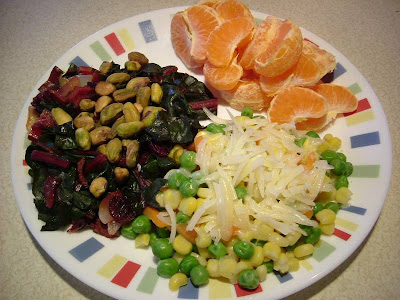
Recent lunch: Organic chard with pistachios and cranberries, organic vegetable mix with shredded asiago cheese, two clementines.
PET scans are expensive, Sandy the nurse said $3500, and for myeloma patients they are not covered by Medicare. However, Medicare is currently funding a study of the usefulness of PET scans for myeloma, so scans are available to a Medicare patient if the patient's doctor is willing to do the paperwork required for the study. Happily, Dr. Lacy was not only willing but suggested the PET scan, for which I will always be grateful.
I was seated in a recliner chair, and Sandy first took a blood sample from a finger, and then injected the isotope (looked like clear water) into a vein. There was no sensation from the injection, except a slight, momentary coolness at the site. Then I sat for an hour, mostly dozing, to give time for the body to distribute the isotope to the organs that were most hungry for the glucose. During that hour I was instructed to be as still as possible, to avoid using muscles, because working muscles demand a refill of glucose, and we wanted as much of the glucose as possible to be free to go elsewhere.
Then I walked to the scanner and laid on a table in front of a big horizontal tube that looked like an MRI scanner, except larger in diameter and shorter in length. As with an MRI, the table scooted me in and out of the tube, but unlike an MRI it was almost silent. It was far less intimidating than a normal MRI. My arms were in an uncomfortable position over my head, or else I would have gone to sleep. The scan itself took about 30 minutes, after which I waited a few minutes more while they checked to see if they got what they wanted. I did ask the technician if there was anything that she could tell me, but she winked "that's what the doctors get the big bucks for."
For me, this seems like the big test. My blood tests have thus far always been negative for the other C.R.A.B. symptoms (organ damage), as have all of the x-rays, so this one is most likely the key test. Sunshine and I agree - whatever the answer, we want to know it, and treatment decisions will probably hinge on it. We'll know in a few days.

Recent lunch: Organic chard with pistachios and cranberries, organic vegetable mix with shredded asiago cheese, two clementines.
Wednesday, November 7, 2007
Weighty Question
Over the past five or six weeks my weight has been dropping, now down to 144 and change, which is the lowest in perhaps 30 years. A very appropriate weight for me I believe. Most people would celebrate this, and I do too, sort of, but I’m logging it just in case it’s a symptom.
It does coincide with my return to running, and I have run two marathons during those weeks, but in the past my running has not caused that much weight loss.
It also coincides with the new myeloma treatment regimen which includes a new drug (LDN), increased supplements, and a substantially changed diet. Those things are most likely the cause. If so, it puts me in the happy position of needing to eat as much as I can, perhaps more than I want, because I don’t think I should lose any more. I can hear you say "poor baby!"
It does coincide with my return to running, and I have run two marathons during those weeks, but in the past my running has not caused that much weight loss.
It also coincides with the new myeloma treatment regimen which includes a new drug (LDN), increased supplements, and a substantially changed diet. Those things are most likely the cause. If so, it puts me in the happy position of needing to eat as much as I can, perhaps more than I want, because I don’t think I should lose any more. I can hear you say "poor baby!"
Friday, September 14, 2007
More Thoughts About Marching
Margaret and Ana, Thank you both for your comments on the previous post. My heros, two kind and clever women in Italy! I do feel better.
The decline of 3% in M-spike is probably well within the margin of repeatability of that test, but at least it suggests that monoclonal proteins did not go UP. I do not know of any reason why the normal IgG should have gone up - I was not dealing with any kind of infection that I know of on blood-draw day - but of course it could be due to a transient subclinical infection of some kind. Perhaps the myeloma is not marching; we shall see in five weeks or beyond.
Meantime I will:
In answer to other very good questions:
The decline of 3% in M-spike is probably well within the margin of repeatability of that test, but at least it suggests that monoclonal proteins did not go UP. I do not know of any reason why the normal IgG should have gone up - I was not dealing with any kind of infection that I know of on blood-draw day - but of course it could be due to a transient subclinical infection of some kind. Perhaps the myeloma is not marching; we shall see in five weeks or beyond.
Meantime I will:
- Continue with the curcumin,
- Add low-dose naltrexone,
- Add resveratrol and perhaps more,
- Get the bone survey (I had a skull MRI done in April),
- Look into the new Life Extension Curcumin and perhaps use that for part of my daily dose,
- Examine the Mayo mSMART concensus protocol more carefully (I believe that this will indicate that I should not treat conventionally until CRAB symptoms appear), and
- Think long and hard about treatment philosophy when and if conventional treatment really is necessary.
In answer to other very good questions:
- The doctor said that some calcium is bound in the IgG, so the calcium measurement in the normal Chem-20 panel would naturally rise with the IgG and might not be a separate indicator. In five weeks he will order another test for what I believe he called "free calcium," which will be more definitive.
- I did not ask about vitamin D but I do take 1000 IU daily, or is it 2000?
- I have had a thyroid test (T4 and another) which were normal. However, my primary physician thinks I neverhteless have the beginning of a goiter (!), so that is a concern and I have started taking a thyroid supplement which includes bovine tissue.
- I will ask my doctor about another cranial or spinal MRI.
- My onc just didn't order the B2M test, for some reason. Since it was also trending up I think he should have, and he said that will be included in five weeks, along with the extra calcium test.
- I've had three BMB's so far, with the most-recent showing only 6.8% plasma cells. However, all three biopsies are from the same hip; next time I will switch hips!
- I'll check into PET as well.
Thursday, September 13, 2007
Marching, Marching ...
Myeloma doesn't give up easily.
I started a curcumin regimen on June 27. Today I got the results. They were not terrible, but sadly, they do not show much benefit from nine weeks of curcumin treatment. Here are some numbers:
Doc and I had quite a discussion today. He really wants to put me on Revlimid right away. I have lots of questions about that, such as:
The doctor believes that time is getting short, looking at the high IgG of 3110. But if that is a problem, it should also show up in other tests, which so far look pretty normal. Or it will show up as lesions in the bones, which we will soon determine. I’m trying to get the right balance here, of risk from the myeloma versus risk from the drugs that treat myeloma.
Meantime, I figure on living life to the fullest. Live one day at a time and make it a masterpiece!
Related links:
I started a curcumin regimen on June 27. Today I got the results. They were not terrible, but sadly, they do not show much benefit from nine weeks of curcumin treatment. Here are some numbers:
- Free lambda light chains are down 12%, and
- “Spike” (SPEP) is down 3% to 1.90 g/dL, but
- IgG is UP 12% to 3110 mg/dL, and
- Serum calcium has edged up to 10.4 mg/dL, which is above the normal range for the first time ever.
Doc and I had quite a discussion today. He really wants to put me on Revlimid right away. I have lots of questions about that, such as:
- Should we hit it easy, shoot for a partial remission and stability, or
- Should we hit it hard, with more drugs, and shoot for a longer-term remission?
- Why Revlimid and not Velcade, when we know that Thalomid (thalidomide), another “IMID” drug, has already failed?
- Why not wait until there are symptoms, as Mayo would do?
- Is the above-normal calcium already a symptom?
The doctor believes that time is getting short, looking at the high IgG of 3110. But if that is a problem, it should also show up in other tests, which so far look pretty normal. Or it will show up as lesions in the bones, which we will soon determine. I’m trying to get the right balance here, of risk from the myeloma versus risk from the drugs that treat myeloma.
Meantime, I figure on living life to the fullest. Live one day at a time and make it a masterpiece!
Related links:
- My Myeloma: A discussion of my myeloma, not very technical.
- My Treatment History: Not technical.
- My Lab Test Charts: Graphic displays of several key test results over time, like the one below showing IgG from 2003 to date.
- My Lab Test Table: Best with a wide browser window. Very technical.
Wednesday, September 12, 2007
Curcumin in Oatmeal
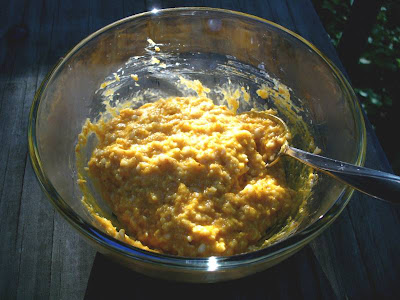
Margaret recently posted some information indicating that the efficacy of curcumin may be improved by heating it. I decided to try some curcumin in my morning oatmeal, to see if that was at all edible.
I'm happy to say that it was edible. In fact, to my surprise, curcumin didn't change the taste of the oatmeal much at all. What does that say about my sense of taste? I don't know. I believe that curcumin may be an important component of the spice turmeric, but it is not the component that imparts flavor! I even used one gram each of two different brands of curcumin. This was only one fourth of my daily eight-gram curcumin dosage, however; it is possible that a full day's dose would impart more flavor (and thus be more objectionable). It did make the oatmeal very yellow, which is not very appealing.
The problem is that I don't know how much heat is necessary to improve curcumin's bioavailability, or how much is too much. Maybe nobody knows. I added the curcumin after the oatmeal was cooked, but it would get a lot more heat if added during the cooking as you would do if you were preparing an Indian dish with turmeric.
Oncologist tomorrow - I'll get my latest test results, including and especially the results of my first two months on curcumin.
I'm happy to say that it was edible. In fact, to my surprise, curcumin didn't change the taste of the oatmeal much at all. What does that say about my sense of taste? I don't know. I believe that curcumin may be an important component of the spice turmeric, but it is not the component that imparts flavor! I even used one gram each of two different brands of curcumin. This was only one fourth of my daily eight-gram curcumin dosage, however; it is possible that a full day's dose would impart more flavor (and thus be more objectionable). It did make the oatmeal very yellow, which is not very appealing.
The problem is that I don't know how much heat is necessary to improve curcumin's bioavailability, or how much is too much. Maybe nobody knows. I added the curcumin after the oatmeal was cooked, but it would get a lot more heat if added during the cooking as you would do if you were preparing an Indian dish with turmeric.

Oncologist tomorrow - I'll get my latest test results, including and especially the results of my first two months on curcumin.
Wednesday, September 5, 2007
Pee in a Bottle
Tomorrow I take the test! Blood test, that is, and I'll contribute my other little donation to the lab.  Usually I get these tests:
I'll see the doctor in another week to review the test results. If the numbers are stable or down, then the curcumin regimen is doing some good and we will no doubt stay the course. If they are up, then I know that the doctor will recommend Revlimid, a fairly new treatment which I am reluctant to start for several reasons. I will most certainly post.
 Usually I get these tests:
- Complete blood counts (CBC), which includes counts of red cells, white cells, platelets, hemoglobin, and the like. Lots more, most of which the doctor doesn't even look at unless they go out of range.
- Chemistry, which includes calcium, sodium, potassium, and other mineral counts plus several other very important indicators such as creatinine (kidneys) and albumin (liver).
- Serum Protein Electrophoresis (SPEP) which shows how much of the protein in the blood is in the form of "monoclonal" proteins that are cast off by the malignant plasma cells of myeloma. This is a crude but important indicator of the actual tumor burden. Myeloma patients call this the "spike," because it actually does show up as a peak on a graph. Bad Spike!
- Light Chains, a particular component of the monoclonal proteins which can clog up internal organs and make things a lot worse, in fact they can make you dead. The doctor tests for light chains in the blood and also in the urine.
- Other stuff. Sometimes they do x-rays, bone density measurements, bone marrow biopsies, and other tests. None scheduled this time, but maybe if the blood tests indicate an issue.
I'll see the doctor in another week to review the test results. If the numbers are stable or down, then the curcumin regimen is doing some good and we will no doubt stay the course. If they are up, then I know that the doctor will recommend Revlimid, a fairly new treatment which I am reluctant to start for several reasons. I will most certainly post.
Sunday, July 1, 2007
Starting Curcumin Regimen
Food Pictures:
You may notice the food pictures on this blog; they're on my running blog too, different ones. I just wrote a post about the food pictures on my running blog here if you're interested.
Curcumin Ramp-up:
So far so good! I've now taken two grams of curcumin for each of two days, and four grams per day for two more days, with no detectable side effects except possibly one (1) hive. Just one place on one shoulder, gone a day later, quite likely not caused by the curcumin, though hives and rash are side effects that have been described by others. Next trick is six grams, which I will do today. If there are side effects I'll back off, otherwise I will hold at this dosage for a few days before increasing to eight grams per day.
I feel good though; a general sense of well-being. That could be in my head, the product of a nice Sunday afternoon heading toward the Fourth of July. But maybe the curcumin plays a part too. It is, after all, an anti-inflammatory and who knows what else. For much more about the benefits of curcumin, in fact ANYTHING about curcumin, see Margaret's Corner.
The Plan:
The curcumin brands mentioned above are described in greater detail in a previous post. A single dose is pictured below, curcumin 2 grams and flaxseed oil one gram.

Organic oatmeal, organic fat-free milk, blueberries, organic strawberries, organic nectarine, organic plum, pecans. Estimated Weight Watchers points = 5.

You may notice the food pictures on this blog; they're on my running blog too, different ones. I just wrote a post about the food pictures on my running blog here if you're interested.
Curcumin Ramp-up:
So far so good! I've now taken two grams of curcumin for each of two days, and four grams per day for two more days, with no detectable side effects except possibly one (1) hive. Just one place on one shoulder, gone a day later, quite likely not caused by the curcumin, though hives and rash are side effects that have been described by others. Next trick is six grams, which I will do today. If there are side effects I'll back off, otherwise I will hold at this dosage for a few days before increasing to eight grams per day.
I feel good though; a general sense of well-being. That could be in my head, the product of a nice Sunday afternoon heading toward the Fourth of July. But maybe the curcumin plays a part too. It is, after all, an anti-inflammatory and who knows what else. For much more about the benefits of curcumin, in fact ANYTHING about curcumin, see Margaret's Corner.
The Plan:
- Single dose: Two grams of curcumin and one gram of oil:
- One gram of "Doctor's Best" curcumin with bioperine
- One gram of "NSI" turmeric extract with bioperine, and
- One gram of "Member's Mark" organic flaxseed oil or another beneficial oil.
- Four of those 2-gram doses per day, between meals:
- Midnight. I get up a few times in the night for BPH anyway.
- 5:00 or 6:00 am, before morning coffee or breakfast.
- 10:30 am, well before lunch.
- 4:30 pm, well before dinner.
- Empty stomach when possible. Experts say this works best. Some bottles of curcumin say to take it with meals, however, so I won't be a stickler.
- If a dose is missed, double up on the next one. Some people take all eight grams at once anyway. I'm spreading it out so that the curcumin is in the blood more of the time, though it might actually work better to take it all at once so that the peak concentration goes higher; I don't know.
- No aspirin. I have been taking an 81-mg aspirin daily for years, but curcumin thins the blood so I will stop. But if I were taking Revlimid or thalidomide, I would certainly want to discuss this with my doctor.
- Two brands, an equal amount from each, on the off-chance that one brand is not up to its advertised standards.
- Margaret also takes quercetin with her curcumin. I don't yet, but may start.
The curcumin brands mentioned above are described in greater detail in a previous post. A single dose is pictured below, curcumin 2 grams and flaxseed oil one gram.

Organic oatmeal, organic fat-free milk, blueberries, organic strawberries, organic nectarine, organic plum, pecans. Estimated Weight Watchers points = 5.

Tuesday, June 12, 2007
Rethinking Proactive Myeloma Treatment
My myeloma is still in a early stage, barely even smoldering. Thankfully, it has not grown rapidly; it seems to double about every 18 months. Nevertheless, I have asked my doctor to be very proactive in two ways: (1) Testing for potential problems, and (2) Treating the disease before symptoms develop. Although studies have shown that early treatment does not result in longer survival, my theory has been that early treatment should at least yield a higher quality of life by delaying symptoms like broken bones and failed kidneys.
Mayo clinic, on the other hand, has recently published a new consensus statement outlining a treatment algorithm for newly-diagnosed myeloma patients titled "Treatment of Newly Diagnosed Multiple Myeloma Based on Mayo Stratification of Myeloma and Risk-Adapted Therapy (mSMART". The abstract is here and the full text is here. It divides newly-diagnosed patients into two groups, high-risk and standard risk, and further divides both of those groups again into a class with active (symptomatic) myeloma and another with smoldering (non-symptomatic myeloma).
Lucky for me, I seem to be in the standard-risk group with smoldering myeloma. For this group, Mayo's algorithm suggests NO treatment. If I had started my doctoring at Mayo Clinic, I would very likely never have taken thalidomide, unless as a participant in a clinical trial. I don't know if that would have been good or bad; I took the thalidomide with my eyes wide open and was glad that my doctor was treating me aggressively. But now I'm thinking I'll ask him to be a little more conservative in treatment. Here are some reasons:
I am very interested in opinions of anyone else who reads this. If you see an error in my facts or my thought process, or even if you agree, I would value your opinion. I'm thinking about my life here. Thanks!
Sunshine and Sweet Pea were out a few nights ago. Incompetent at cooking, I had to make do:
A banana, an orange, organic strawberries, blueberries, organic yogurt, pistachios, asiago cheese, organic red wine. Estimated Weight Watchers points = 11. The cheese alone is six points.
Mayo clinic, on the other hand, has recently published a new consensus statement outlining a treatment algorithm for newly-diagnosed myeloma patients titled "Treatment of Newly Diagnosed Multiple Myeloma Based on Mayo Stratification of Myeloma and Risk-Adapted Therapy (mSMART". The abstract is here and the full text is here. It divides newly-diagnosed patients into two groups, high-risk and standard risk, and further divides both of those groups again into a class with active (symptomatic) myeloma and another with smoldering (non-symptomatic myeloma).
Lucky for me, I seem to be in the standard-risk group with smoldering myeloma. For this group, Mayo's algorithm suggests NO treatment. If I had started my doctoring at Mayo Clinic, I would very likely never have taken thalidomide, unless as a participant in a clinical trial. I don't know if that would have been good or bad; I took the thalidomide with my eyes wide open and was glad that my doctor was treating me aggressively. But now I'm thinking I'll ask him to be a little more conservative in treatment. Here are some reasons:
- All treatments have side effects. For example, with thalidomide I had rash, low heart rate, erectile dysfunction, slow bowel, weight gain, and possibly a minor deep-vein thrombosis and peripheral neuropathy. Happily, none of those were show-stoppers, and all but the rash are gone now. However, the next step for me is Revlimid with dexamethasone, which could easily cause more-serious side effects.
- To some extent, each treatment may be thought of as an arrow in the quiver. Once it's been shot, it's gone. Thalidomide seemed to work at first, but not any more, and it will most likely be unavailable later when I might need it more.
- Treatments can cause the myeloma to mutate and become more aggressive. I suppose this is why early treatment doesn't actually extend survival. Since my myeloma is progressing slowly now, maybe I'm better off not provoking it unnecessarily.
- Treatments can cause other cancers. I think that applies mostly to the older, standard chemotherapy treatments like melphalan, but those treatments may be all that remain for me if I use up the other arrows in the quiver too soon.
- Treatments can even cause the very symptoms that we are most trying to avoid from the myeloma. I know a man whose kidneys are failing because of treatments, not because of the myeloma.
I am very interested in opinions of anyone else who reads this. If you see an error in my facts or my thought process, or even if you agree, I would value your opinion. I'm thinking about my life here. Thanks!
Sunshine and Sweet Pea were out a few nights ago. Incompetent at cooking, I had to make do:

A banana, an orange, organic strawberries, blueberries, organic yogurt, pistachios, asiago cheese, organic red wine. Estimated Weight Watchers points = 11. The cheese alone is six points.
Saturday, June 2, 2007
Curcumin Arrived
I ordered modest quantities of each of three different brands of curcumin, just to see what they were like. See previous post. I'll start taking it in a few weeks, and by then will necessarily order quite a bit more from one or more of these sources.
The proposed amount per day is 8 grams (8000 mg), divided into two or more doses. I may decide to alternate two or three brands, on the off chance that the quality of one brand is not as high as advertised. I already do that with my multivitamin.
The capsules from Doctor's Best brand are sufficiently distinguishable from the capsules from NSI brand that I think they do come from different manufacturing sources. The caplets from AFI are quite different, more dense, and clearly not from the same manufacturing process. All of the capsules and caplets weigh significantly more than the amount of curcumin they purport to contain, a good sign.
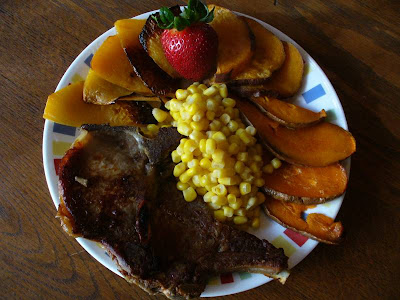
Thin-cut pork chops, corn, oven-roasted rutabaga, two kinds of oven-roasted sweet potatoes, strawberry garnish.
 |
Per Caplet:
|
Per TWO capsules:
|
 |
 |
Per TWO capsules:
|
The capsules from Doctor's Best brand are sufficiently distinguishable from the capsules from NSI brand that I think they do come from different manufacturing sources. The caplets from AFI are quite different, more dense, and clearly not from the same manufacturing process. All of the capsules and caplets weigh significantly more than the amount of curcumin they purport to contain, a good sign.

Thin-cut pork chops, corn, oven-roasted rutabaga, two kinds of oven-roasted sweet potatoes, strawberry garnish.
Saturday, May 26, 2007
Curcumin Sources in the USA
In a few weeks I'll be taking eight grams (8000 mg) of curcumin daily, with bioperine to enhance "bioavailability." I did a quick search to find sources. NOW has a nice 665-mg tablet, which I have been taking for some time, just one per day, but it does not contain bioperine. I could take the bioperine separately, but curcumin containing bioperine is readily available.
This was NOT an exhaustive search. Nothing is guaranteed, especially the prices and quantities. The following five sources include four different brands of curcumin with bioperine, in a variety of dosages per capsule. In the table below:
I ordered from three of these sources this week, and received curcumin from VitaCost; the others should arrive next week.

Romaine, cucumber, fennell, avocado, strawberries, blackberries, blue cheese, raspberry vinegar. Estimate: Two Weight Watchers points.
This was NOT an exhaustive search. Nothing is guaranteed, especially the prices and quantities. The following five sources include four different brands of curcumin with bioperine, in a variety of dosages per capsule. In the table below:
- "mg" is the milligrams of curcumin per capsule,
- "Qty" is the number of capsules per bottle,
- "$Cost" is the cost per bottle, somewhat dependent on quantity purchased,
- "$/8 gm" is the cost per eight grams, the daily dose,
- "Doses" is the number of 8-gm doses per bottle, and
- "Bioperine" is the amount of bioperine per capsule in mg.
| Curcumin Brand | Web Site | mg | Qty | $Cost | $/8 gm | Doses | Bioperine |
| Proprietry C3 Complex | agelesscures | 1000 | 100 | 26.95 | 2.16 | 13 | 5 |
| AFI C3 Complex | doctorstrust | 1000 | 60 | 14.09 | 1.88 | 8 | 5 |
| Doctors Best | clubnatural | 500 | 120 | 15.00 | 2.00 | 8 | 3 |
| NSI Extract | vitacost | 550 | 120 | 18.99 | 2.30 | 8 | 2.5 |
| Super Curcumin | lef | 800 | 60 | 18.68 | 3.11 | 6 | 5 |

Romaine, cucumber, fennell, avocado, strawberries, blackberries, blue cheese, raspberry vinegar. Estimate: Two Weight Watchers points.
Monday, May 14, 2007
Don's Thalidomide Experience
May 14, 2007
I am a very active 66-year-old man with “smoldering” myeloma, and have taken thalidomide on two occasions. Each time I took the smallest dose, 50 mg, for three or four weeks, then a week or two off, repeating for several months. I did not take dex with it. The first time, early 2004, it reduced my lambda light-chain count (FreeLite test) significantly. The second time, early 2007, it had less effect and is probably now a "failed regimen." I have stopped taking it and will try something else.
Thalidomide is an innocuous-looking little capsule, but it has powerful and disparate effects on the human body. I know from support-group discussions that those effects are different for different people. These are my own experiences with it.
Intended benefits:
| Remission: | The initial course of thalidomide in 2004 produced a dramatic decrease in lambda light chains, a dangerous blood protein produced by the malignant cells. Those light chains have never since risen as high as they were before that first thalidomide. We don't know, however, if the initial course reduced the actual number of malignant cells (tumor burden) because we were not then using the best measurement of that, the serum protein electrophoresis (SPEP) test. But we do know that remission was not achieved in the second course. Here is a set of charts of test results versus time, and here are the actual numbers, showing that IgG and the SPEP "spike" continued to increase throughout the second course. |
Unintended benefits:
| BPH: | I have benign prostatic hyperplasia (BPH), which makes it hard to empty my bladder, especially at night, so I usually have to get up to pee four or even five times each night. It's not prostate cancer - it's something that happens to lots of aging guys. While on thalidomide, that condition improved enough that I needed to get up only about twice per night. The benefit disappeared almost immediately upon discontinuing the thalidomide. | |
| Sleep: | On thalidomide I always slept very soundly and awoke refreshed. Part of the reason may be the BPH benefit just described above, but I think the thalidomide improved the quality of sleep in other ways too. That benefit also disappeared immediately after discontinuing thalidomide. |
Unintended negative effects:
| Rash: | The first course of thalidomide gave me a rash which began within a few days and persisted for months after thalidomide was discontinued. It was mostly on skin exposed to the sun, but happily not on my face or neck. I expected that rash during the second course, but it only appeared after several months in a milder form, and then was mostly on my torso, normally not exposed to the sun. It itches a little, and has persisted for a month now after the thalidomide was discontinued. | |
| Slow waking heart rate: | Medical term: Bradycardia. Because I'm a serious runner, I take my waking heart rate every morning to check for overtraining problems. My normal waking heart rate is 48, but on thalidomide it drops about eight points to an average of about 40. I've seen it as low as 36. In some people this may cause a general feeling of fatigue or even dizzyness; I didn't notice that but I do think that thalidomide hampered my running speed slightly. | |
| Peripheral neuopathy: | Most people taking thalidomide will experience peripheral neuropathy if they take it long enough. I'm told that it appears as numbness, tingling, or pain in feet and hands. I did experience some numbness in one foot, especially while running. Neuropathy from thalidomide is usually more symmetrical, however, so this may have another cause. Furthermore, neuropathy from thalidomide usually persists and may even continue to worsen for a while after thalidomide is discontinued, but this went away. | |
| DVT: | Medical term: Deep vein thrombosis, a blood clot. Anyone can get a DVT, but thalidomide makes it much more likely. Often the clot appears deep in a calf or thigh muscle. I did have a sharp cramp-like pain toward the bottom of a calf muscle near the end of the last course of thalidomide. It was probably from running, but it was unlike any running cramp I have experienced before. I treated it with extra aspirin (I was taking some anyway), massage, and did not take thalidomide that night. It was gone the next day. We'll never know whether it was a DVT. | |
| ED: | Medical: Erectile dysfunction. Yes that's still important. Fortunately the problem was easily overcome by a little pill, and it disappeared when thalidomide was discontinued. | |
| Slow bowel: | Medical: Constipation. Only a minor problem in my case. The problem disappeared when thalidomide was discontinued. | |
| Weight gain: | I am a Weight Watcher and monitor my caloric input very carefully. When I took thalidomide I would gain about four pounds, and when I stopped taking it the weight came off again. I think it was fluid, not fat. | |
| Thyroid: | Medical: Hypothyroid. In some people thalidomide will depress thyroid function, leading to classic symptoms of hypothyroidism such as fatigue, bradycardia, weight gain, aches and pains, and intolerance to cold. It is possible that I did have depressed thyroid function, which could account for the bradycardia and weight gain, but we did not perform thyroid function tests while on thalidomide so we'll never know. |
Saturday, May 12, 2007
First Post
Until now, my running blog Make It a Masterpiece has included posts about both running and myeloma. No one has complained, but I suspect that most of the people interested in myeloma issues don't care much about the running posts, and vice-versa.
As of today, May 12, 2007, this new blog Myeloma Hope is created as my diary for NEW posts related to myeloma. I'm not sure how to move old myeloma posts from one blog to the other, however, so those will remain on Make It a Masterpiece.
Each blog will have clear links to the other, but if you have posted a link to Make It a Masterpiece on YOUR blog, and your blog is about myeloma, I hope you will switch the link to Myeloma Hope. I should have done this long ago.
Each blog will have its own RSS Feed, so you can be alerted to new posts if you care to.

As of today, May 12, 2007, this new blog Myeloma Hope is created as my diary for NEW posts related to myeloma. I'm not sure how to move old myeloma posts from one blog to the other, however, so those will remain on Make It a Masterpiece.
Each blog will have clear links to the other, but if you have posted a link to Make It a Masterpiece on YOUR blog, and your blog is about myeloma, I hope you will switch the link to Myeloma Hope. I should have done this long ago.
Each blog will have its own RSS Feed, so you can be alerted to new posts if you care to.

Subscribe to:
Posts (Atom)


